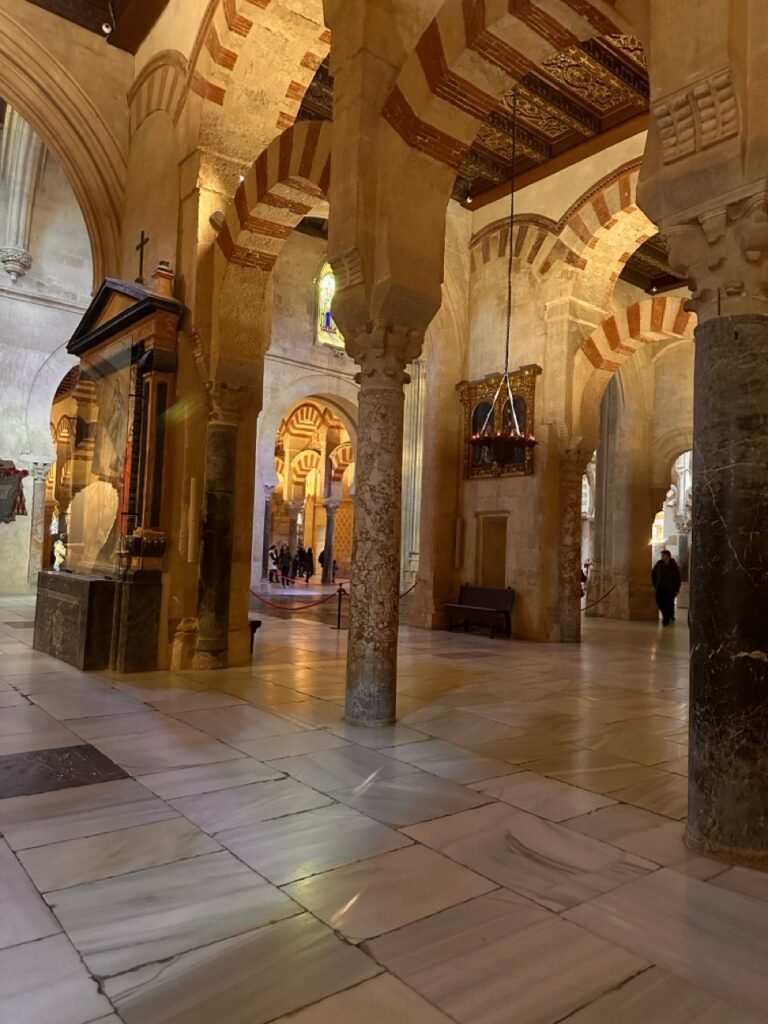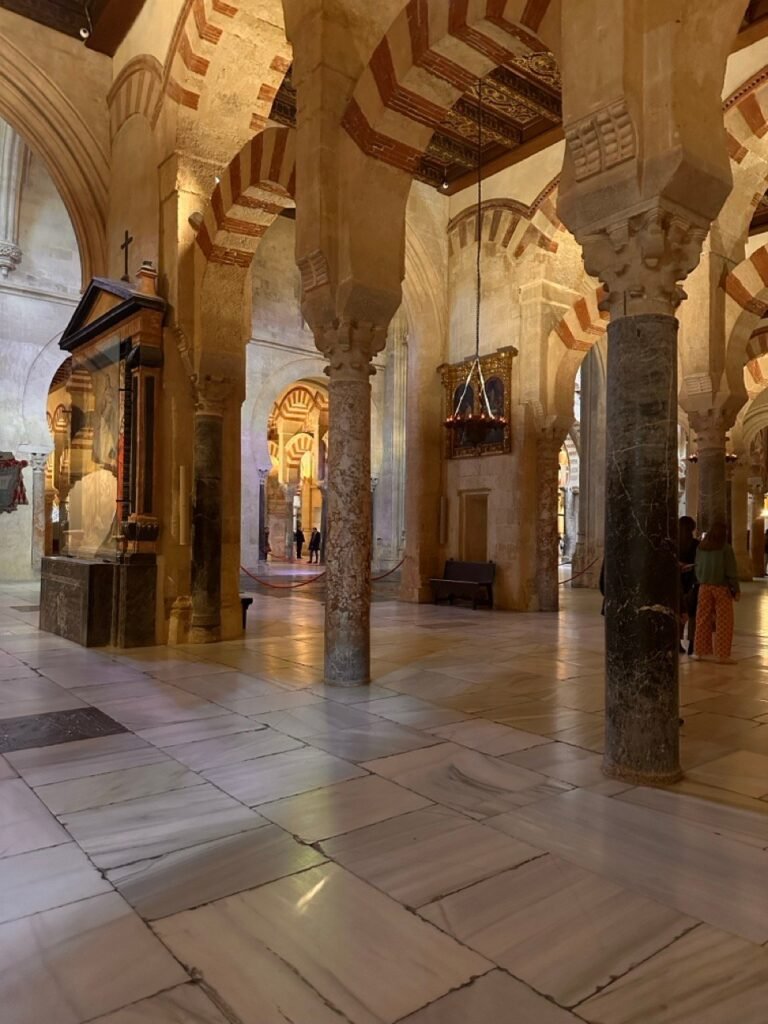
The Great Mosque of Córdoba is one of the strangest and most beautiful buildings in Europe: a mosque that grew for more than two centuries, then had a cathedral built right into its heart. This page tells the story of how that happened, stage by stage, and what each stage left for you to see.
Our visit
We have been inside the Mezquita and the photos on this page are ours. The history is researched from the monument’s official website and Wikipedia, checked on 12 November 2026. Where sources disagree about a date, we say so instead of picking one.
One building, many names
In English you will see it called the Great Mosque of Córdoba, the Mosque-Cathedral or simply the Mezquita, the Spanish word for mosque. Its official name as a church is the Cathedral of Our Lady of the Assumption, and the monument’s own website calls it the Mosque-Cathedral Monumental Site of Córdoba. All of these names are the same building.
This page is the history behind the visit. If you are planning one, our main Mezquita guide has our own tips, and separate pages cover tickets, opening hours, free entry and guided tours.
Before the mosque
The site was already sacred before 786. The official website describes a Visigothic basilica dedicated to Saint Vincent here, dating to the middle of the 6th century. Wikipedia adds the traditional account that the Christian community sold its half of the site to the new Muslim rulers, and that the church was then demolished; it also notes that scholars debate the details. What is clear is that the mosque was built on a place that already mattered.
Abd al-Rahman I: the first mosque
Córdoba became the capital of the Umayyad rulers of Al-Andalus under Abd al-Rahman I, who began the mosque in the 780s. Sources differ by a year or two: the official site’s timeline places the first building in 786 to 788, while Wikipedia gives 785 as the start. The first mosque was a rectangular prayer hall of eleven aisles (naves) running at right angles to the wall that faces Mecca, with an open courtyard to the north. The official timeline also dates the first minaret to 788, under Abd al-Rahman’s son Hisham I.
Four enlargements in two centuries
As the city grew, so did the mosque. The prayer hall was extended four times, and each ruler left something recognisable. The dates below follow the official timeline; Wikipedia gives slightly different years for some stages, which is normal for a building this old.
| When | Ruler | What was added |
|---|---|---|
| 833 to 848 | Abd al-Rahman II | Eight more aisles to the south; the ablution courtyard enlarged |
| 951 to 952 | Abd al-Rahman III | A new minaret, reportedly 47 m high (later enclosed in the bell tower) |
| 962 to 966 | Al-Hakam II | The prayer hall extended again, with the royal enclosure (maqsura) and the area of the mihrab; Wikipedia says the mihrab section was finished around 971 |
| 991 to 994 | Almanzor (al-Mansur) | A wide extension to the east, because the river blocked further growth to the south; Wikipedia gives 987 to 988 |
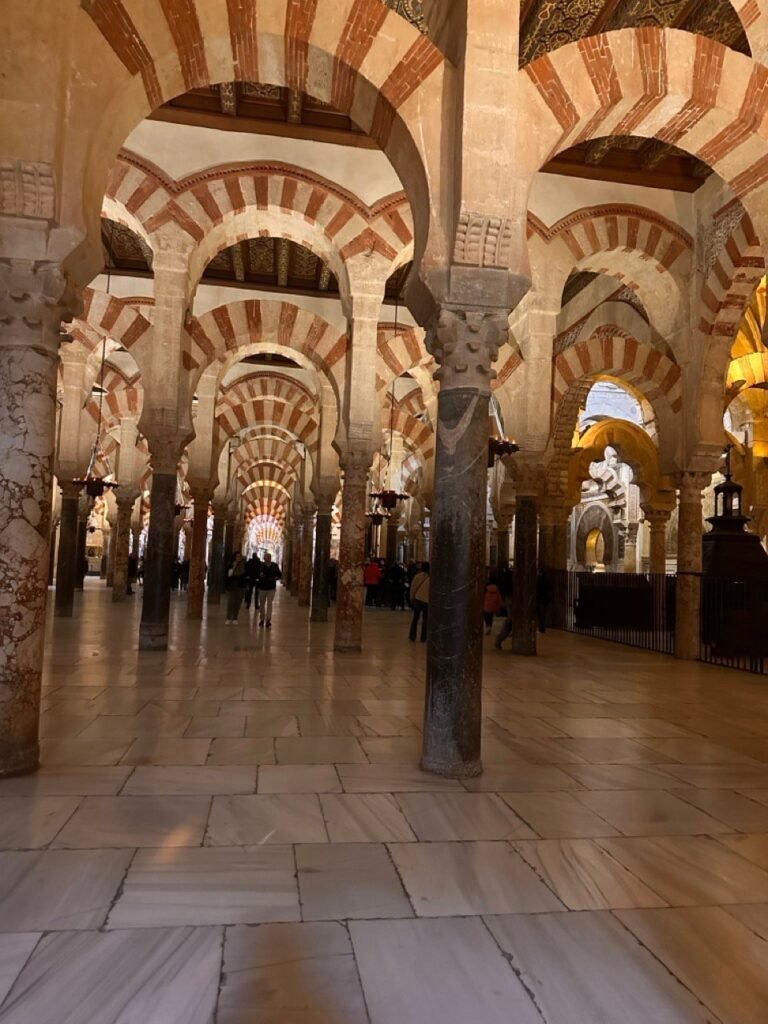
Because every extension kept the same system of columns and arches, the result feels like one huge, continuous hall, even though it was built over more than 200 years.
The forest of double arches
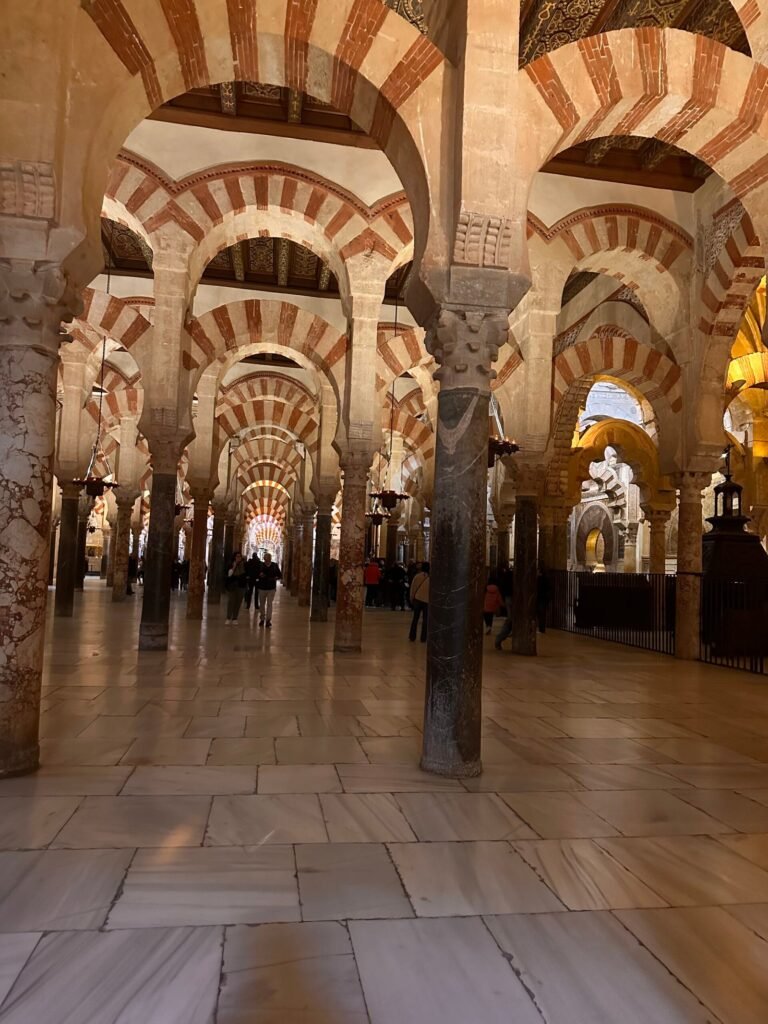
The famous look of the Mezquita comes from a clever structural trick. Two levels of arches stand on slender columns: a lower horseshoe arch and, above it, a higher semicircular arch that carries the roof. This lets the ceiling rise higher than the short columns could manage on their own. The arches are striped in red brick and white stone, which is why the hall seems to glow.
Many of the columns and capitals were not made for this building: they were reused (spolia) from earlier Roman and Visigothic structures, which also sped up the work, according to Wikipedia. Counts of the columns differ between sources, from roughly 850 to well over 1,000 depending on what is included, so we do not give a single number. If you want to explore this part, see the photos below and our main guide for what to look for.
The mihrab
The most richly decorated part of the mosque is the mihrab, the prayer niche, and the area around it from the extension of al-Hakam II. Gold-ground mosaics cover the arch and the dome in front of it. The official site notes that the mosaics of the mihrab were restored in 1816.
From mosque to cathedral
After Ferdinand III of Castile captured Córdoba in 1236, the mosque was consecrated as a cathedral, and the official website records a mass on 29 June 1236. Christian chapels were added around the edges over the following centuries. The official site lists the Royal Chapel, completed in 1371, and a Gothic nave begun in 1489.
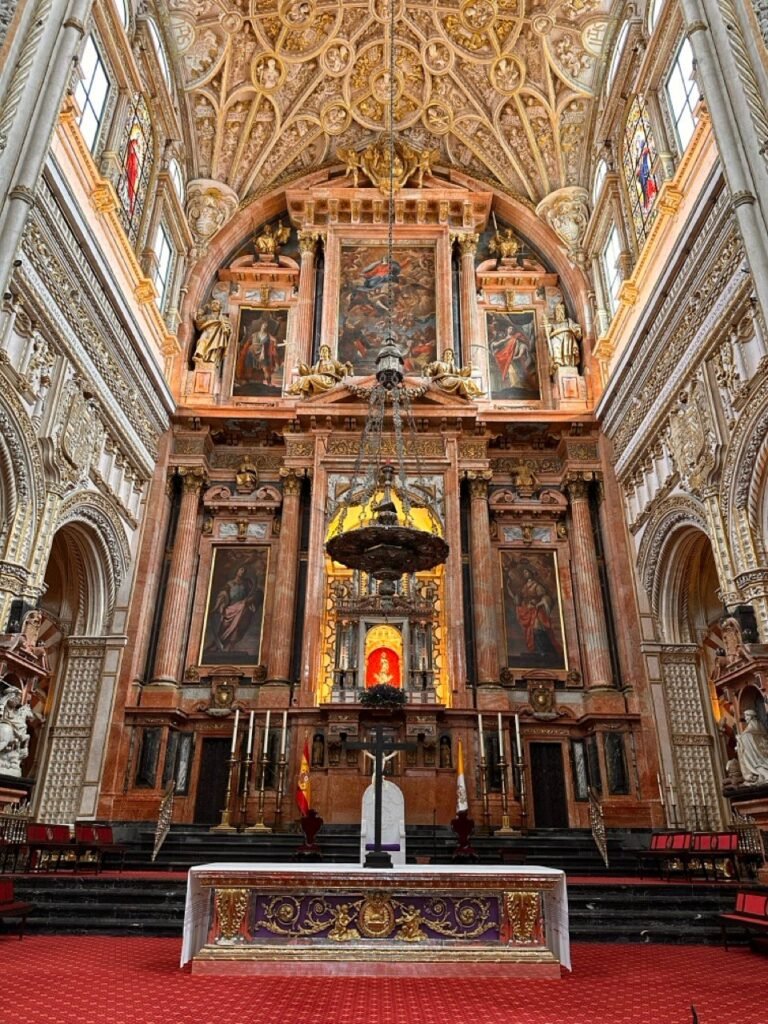
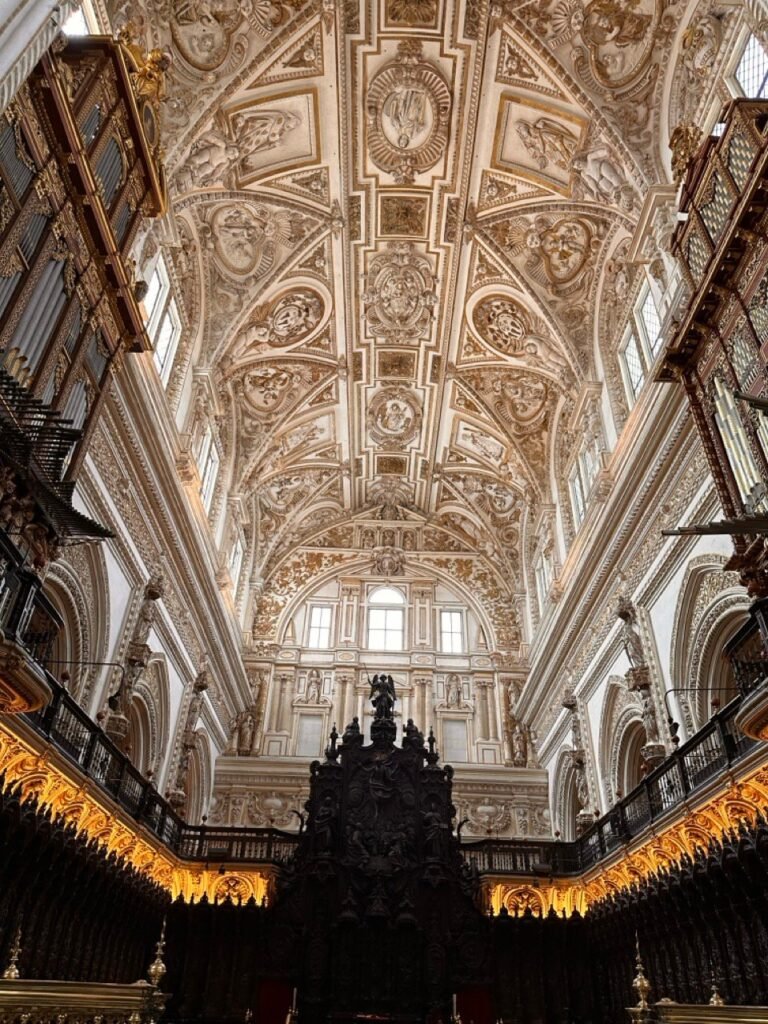
The big change came in the 16th century. The official history says that Bishop Alonso Manrique ordered a Renaissance cathedral built in the middle of the prayer hall, and that the architect Hernán Ruiz I started it in 1523, a date still recorded in an inscription on one of the arches. The crossing dome and the choir vault by Juan de Ochoa date from 1599 to 1607. According to a well-known story, the Emperor Charles V saw the result and regretted that something unique had been destroyed to build something ordinary.
Inside the cathedral part you can see the main altarpiece (begun in 1618 and completed in 1713, per the official site) and the carved choir stalls, which Pedro Duque Cornejo began in 1748 and which were finished in 1757.
The minaret becomes a bell tower
The 10th-century minaret still stands inside the bell tower. From 1593 the architect Hernán Ruiz III enclosed it in a thick wall and added the bell body above, and the tower was restored from 1991 and opened to visitors in November 2014, according to the official site.
The Orange Tree Courtyard
The open courtyard, the Patio de los Naranjos, was where worshippers once washed before prayer. The official history credits Bishop Francisco de Reinoso with the garden layout of 1597 to 1601: three squares with paths, planted with orange trees, cypresses and palms.
Protected since the 19th century
Restoration work by the architect Ricardo Velázquez Bosco ran from 1879 to 1923, and the building was declared a National Monument by a Royal Order of 21 November 1882. UNESCO inscribed the monument on the World Heritage List in 1984, and the protected area was later extended to the whole historic centre.
What the history means for your visit
Walk in slowly. Start in the oldest part, the early aisles with their stripes and low arches, and then follow the building as it grows, noticing where the ceiling and the light change, until you reach the Renaissance nave and the cathedral. Allow time for the courtyard and the tower.
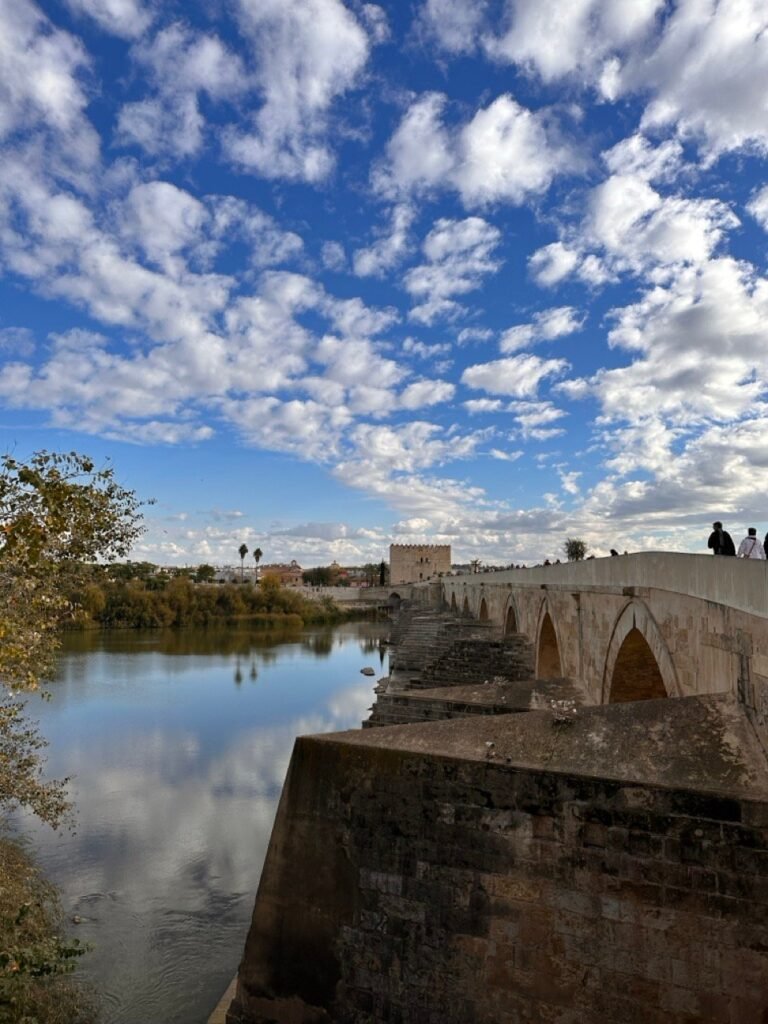
After the visit, the old town is right around you: cross the Roman Bridge, visit the Alcázar where Castilian kings later lived, or walk through the Judería. For the earlier chapter of the same dynasty, visit Medina Azahara, the palace-city built by Abd al-Rahman III. For dinner, see restaurants near the Mezquita.
Sources
Sources: Mosque-Cathedral of Córdoba: history (official site); Mosque-Cathedral of Córdoba: the building and timeline (official site); Wikipedia: Mosque-Cathedral of Córdoba. Information checked on 12 November 2026. Dates differ between sources; we followed the official timeline where it gives one.
Keep exploring
Related guides