
Of all the dishes of Córdoba, rabo de toro is the one people tend to have a strong opinion about. It is a rich, slow-cooked stew of bull’s tail, and it is as traditional here as it gets. I loved it. My girlfriend, let’s say, was less convinced.

Our experience
We ate rabo de toro at Puerta Sevilla in San Basilio. I really enjoyed it. My girlfriend liked it less, which is worth knowing: it is a dish you either love or you do not.
What is rabo de toro?
Rabo de toro is Spanish for bull’s tail, and it is also the name of the stew made with it. The tail is cut into sections and braised slowly until the meat is tender enough to fall from the bone, in a sauce that gets thick and glossy from the gelatin in the tail. The tail itself is a classic oxtail cut: according to Wikipedia, the word oxtail now covers the tail of any cattle, and the meat is rich in gelatin, which is why it is usually stewed or braised for a long time.
The Spanish Wikipedia describes it as a typical Córdoba stew made from the tail of a cow or a bull, also common elsewhere in Andalusia. The Córdoba tourist office lists rabo de toro among the characteristic meat dishes of the city.
Where does it come from?
The usual story links the dish to bullfighting. The Spanish Wikipedia says it was originally made with the tails of fighting bulls after the corrida, and the Córdoba tourist office also ties its origin to the city’s bullfighting history. The same article places the dish’s origin in 16th-century Córdoba, but it does not give a firm source for that, so we treat the date as a tradition rather than a fact. Nowadays, many kitchens will use the tail of a cow or ox rather than one from a fighting bull, so the name often says more about tradition than about the animal. If you are curious about the culture behind it, see our page on Ronda, whose famous bullring we visited.
How it is made
There are many versions, but recipes you will find for the Córdoba style share a few steps: the pieces of tail are floured and browned, then simmered with onion, garlic, carrot and tomato in wine. Some cooks use red wine, while the recipe of the brotherhood devoted to the dish uses fino wine from Montilla-Moriles, and other cooks use amontillado. Cooking times differ a lot between recipes, from about two hours to four, because the real test is that the meat comes off the bone. It is usually served with potatoes, either fried or mashed, and sometimes with rice.
These are the general lines of published recipes, not a recipe of ours.
Our verdict
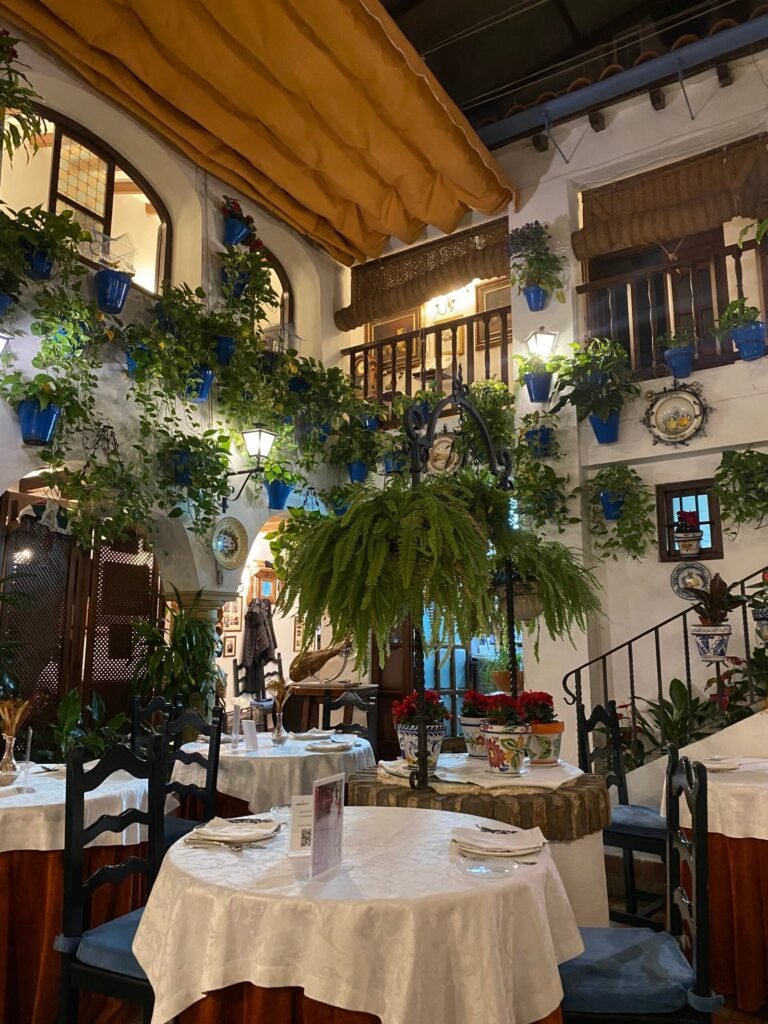
At Puerta Sevilla, in a 200-year-old house with a flower-filled patio, I really enjoyed it. It is the kind of food that suits a cool evening: deep, savoury and heavy. My girlfriend found it less to her taste, so we would say: if you like slow-cooked meat, rich sauces and a rustic dish, order it; if you are unsure, share one portion and order something lighter alongside, like salmorejo or flamenquín.
How to order it
Look for rabo de toro on the menu under meat (carnes) or on the list of Córdoba specialities. It is often a main course, sometimes also served as a smaller portion or media ración. If it is not on the menu at lunch, ask: it is a stew, and some places make it daily while others only serve it when the cooking is ready. For more dishes to try, see our guide to local food and tapas, and our ratings of the restaurants we visited.
Sources
Sources: Wikipedia (Spanish): Rabo de toro; Wikipedia: Oxtail; Córdoba Tourism: Córdoba cuisine; Directo al Paladar: recipe of the Cofradía del Rabo de Toro Cordobés; Infobae: Rabo de toro a la cordobesa. Information checked on 12 November 2026.
Keep exploring
Related guides